
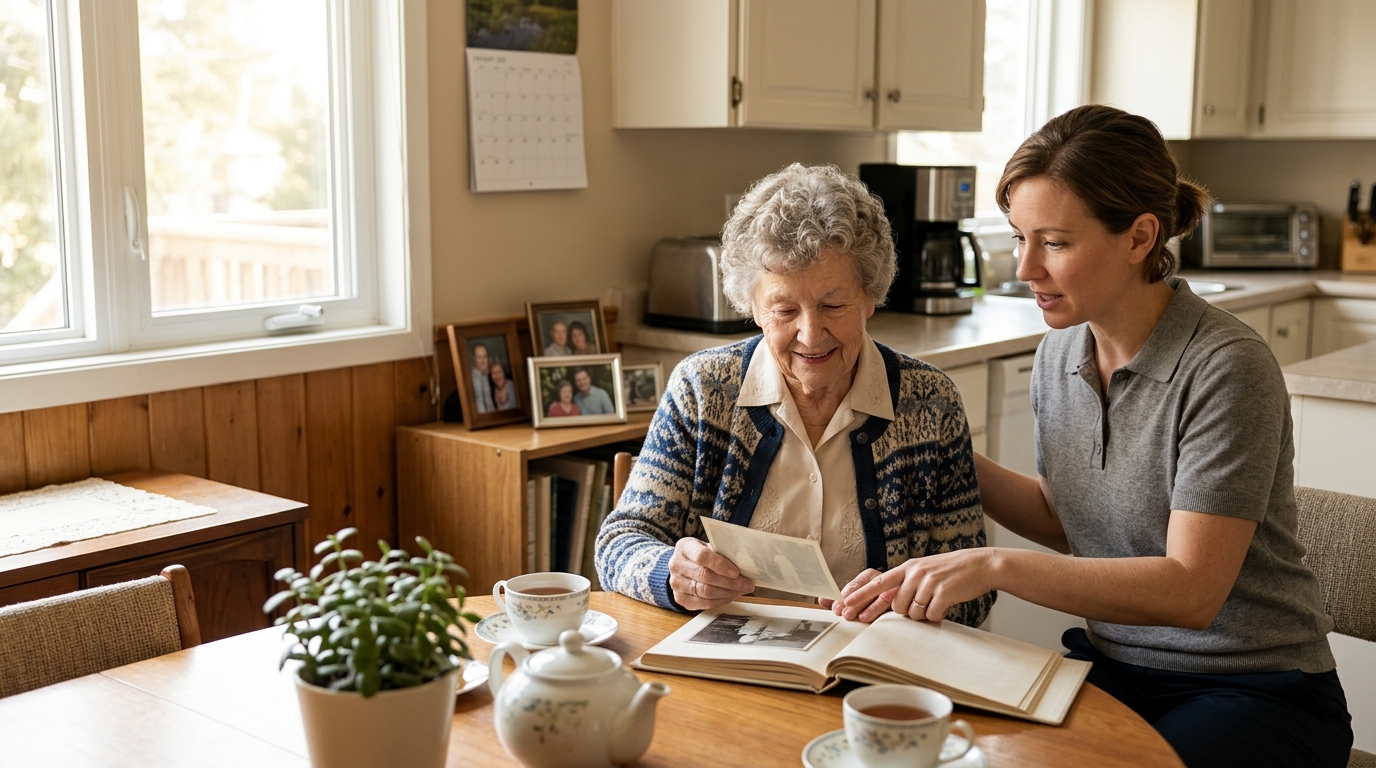
Dementia Home Care Guide
Home Care for Seniors With Dementia: What Families Need to Know
Caring for a senior with dementia at home can become more challenging as memory loss and cognitive changes progress.
What may have been manageable for your family a year ago may now require more time, supervision, or hands-on help.
And dementia care isn't simply about helping someone complete everyday tasks.
The right Caregiver needs to understand the person's routines, preferences, communication style, and the ways dementia can affect their behaviour and independence.
For families, one of the biggest questions is often:
How can we provide enough support while helping our loved one remain comfortable and at home?
Home care can provide practical assistance while also giving family caregivers more time to work, rest, manage other responsibilities, and simply spend time with their loved one as family.
Last updated:
What Does Dementia Home Care Include?
Dementia home care is personalized support for someone living with Alzheimer's disease or another form of dementia.
The type and amount of support can vary significantly.
Someone in the earlier stages of dementia may primarily need reminders, companionship, help with meals, and assistance staying organized.
Someone with more advanced dementia may need help with personal care, mobility, eating, toileting, supervision, and maintaining a consistent daily routine.
Home care may include:
- Personal care such as bathing, dressing, grooming, and toileting
- Meal preparation and mealtime support
- Medication reminders
- Companionship and conversation
- Familiar activities and engagement
- Help maintaining daily routines
- Mobility and safety support
- Light household tasks
- Supervision
- Support with appointments and errands
- Respite for family caregivers
The goal isn't to take over everything your loved one does.
It's to provide the right level of support while preserving as much independence and dignity as possible.
Why Routine Matters So Much in Dementia Care
For someone living with dementia, familiar routines can provide a sense of stability.
A change that seems small to the rest of the family—having breakfast at a different time, moving furniture, changing the person helping with morning care—can sometimes be confusing or upsetting.
This is why dementia home care should be built around the person's existing routines whenever possible.
A Caregiver may become familiar with things such as:
- What time the person normally wakes up
- How they like their breakfast prepared
- How they prefer to get dressed
- What activities they enjoy
- What music they like
- When they normally rest
- How they prefer to communicate
- What tends to cause frustration
- What helps them feel calm
- How they like their evening routine to work
The more the Caregiver understands the person's normal rhythm, the less the care experience can feel like a series of interruptions.
Familiarity With the Caregiver Can Make a Difference
One of the biggest challenges families face with dementia care is introducing someone new.
A person living with dementia may not readily accept a stranger coming into their home—even when that person is qualified and experienced.
They may ask:
"Who is this?"
Or:
"Why do I need someone here?"
This is one reason caregiver continuity can be particularly valuable in dementia care.
Over time, a familiar Caregiver can become part of the person's routine.
The Caregiver learns their preferences, communication style, habits, and triggers. The senior becomes familiar with the Caregiver's presence and approach.
That familiarity can make care easier for everyone involved.
At Vidal, families can choose their Caregiver based on factors including experience, availability, and the type of support needed. Vidal's dementia-care approach also emphasizes familiar routines and, when possible, keeping the same Caregiver over time.
For more guidance, see How to Find a PSW for an Aging Parent.
Choosing a PSW With Dementia Experience
Not every PSW will have the same experience with dementia.
When looking for home care, ask whether the Caregiver has experience supporting someone with:
- Alzheimer's disease
- Memory loss
- Confusion
- Changes in behaviour
- Difficulty communicating
- Wandering or safety concerns
- Resistance to personal care
- Changes in eating habits
- Reduced mobility
- Increasing dependence on others
Additional training can also be relevant.
Some Caregivers have specialized training or experience related to dementia care. Vidal, for example, identifies additional training such as U-First!® and Gentle Persuasive Approaches (GPA)® among some Caregiver qualifications, and matches families with Caregivers who have relevant experience with dementia and other specialized care needs.
The important question isn't simply:
"Is this person a PSW?"
It's:
"Does this person have the experience and approach that fit my loved one's needs?"
Personality Matters as Much as Qualifications
Dementia care is highly personal.
A Caregiver can have excellent qualifications and still not be the right match for a particular senior.
Look for someone who is:
- Patient
- Calm
- Respectful
- Consistent
- A good listener
- Comfortable repeating information
- Able to communicate simply and clearly
- Respectful of personal preferences
- Comfortable encouraging independence
- Able to remain calm when a situation becomes frustrating
For some seniors, a quiet and gentle personality may be particularly important.
For others, a more energetic Caregiver who enjoys conversation and activities may be a better fit.
This is one reason caregiver choice can matter so much.
For more guidance, see What Questions Should You Ask When Hiring a PSW?.
Supporting Independence Instead of Taking Over
It can be tempting to do everything for someone with dementia.
But doing everything may remove opportunities for independence that the person can still maintain.
Instead, a Caregiver can provide the amount of assistance needed while allowing the senior to participate whenever possible.
For example:
Instead of dressing someone completely, the Caregiver might lay out clothing and let the person choose what to wear.
Instead of preparing the entire meal, the Caregiver might involve the senior in a familiar part of the process.
Instead of taking over an activity, the Caregiver might provide reminders or gentle assistance.
The goal is not to test what someone can do.
It is to support them without unnecessarily taking away the things they can still manage.
What Does a Typical Day of Dementia Home Care Look Like?
There isn't one standard schedule.
A Caregiver might help with:
Morning
- Getting out of bed
- Toileting
- Bathing or washing
- Dressing
- Breakfast
- Medication reminders
- Getting oriented to the day
Midday
- Lunch
- Hydration
- A walk or familiar activity
- Companionship
- Light housekeeping
- Errands or appointments
Afternoon
- Snacks and hydration
- Activities
- Conversation
- Rest
- Supervision
Evening
- Dinner
- Personal care
- Changing into comfortable clothing
- Preparing for bed
- Establishing a familiar nighttime routine
The schedule should reflect what your loved one actually needs.
Some families may only need a few hours of support each week. Others may eventually need daily, extended, or overnight care.
Vidal's dementia-care service is designed around this flexibility, with support that can increase or change as the person's needs progress.
How Much Home Care Does Someone With Dementia Need?
There is no universal number of hours.
The answer depends on:
- Stage of dementia
- Ability to manage personal care
- Mobility
- Safety concerns
- Whether the person can be left alone
- Behavioural or communication changes
- Family availability
- Existing support
- Whether the person lives alone
- Overnight needs
A person in the earlier stages may need a few scheduled visits each week.
As dementia progresses, they may need daily assistance or more continuous supervision.
Rather than choosing a number of hours first, start by identifying when your loved one needs help.
For example:
"She manages her mornings independently but needs help with lunch and becomes increasingly confused in the afternoon."
That tells you much more about the care schedule you need than simply saying:
"We need a PSW."
For more guidance, see How to Choose the Right Home Care for a Loved One.
What If Your Loved One Refuses Care?
This is one of the hardest situations for families.
Someone with dementia may not understand why they need help or may perceive a new Caregiver as an intrusion.
Trying to force the issue can make the situation worse.
Instead, consider:
Introduce support gradually
Start with shorter visits if appropriate rather than immediately introducing a long daily schedule.
Give your loved one choices
Let them participate in decisions about when the Caregiver comes and what activities they do together.
Focus on practical help
Instead of saying, "You need a caregiver," try:
"Someone is going to come by and help with lunch."
Build familiarity
If possible, keeping the same Caregiver can reduce the number of unfamiliar people entering the home.
Find the right personality
Some people respond much better to one Caregiver than another.
This is another reason caregiver matching is important.
What If the Usual Caregiver Is Unavailable?
This can be particularly difficult with dementia.
Families sometimes worry that bringing in an unfamiliar replacement will create more stress than simply going without care.
That's why continuity should be considered when building a dementia-care plan.
When selecting a Caregiver, think beyond the immediate schedule.
Ask:
- Can this person potentially become a regular Caregiver?
- Do they have experience with dementia?
- Is their availability compatible with the schedule we expect to need?
- Would their personality work well with my loved one?
- What happens if they are sick or unavailable?
- Is there support available if we need to change Caregivers?
Having a plan for coverage before a problem occurs can make an unexpected absence much easier to manage.
Dementia Care Is Also Care for the Family
Dementia can gradually shift a large amount of responsibility onto family members.
A daughter may become responsible for meals, appointments, medication reminders, shopping, transportation, household tasks, and supervision.
A spouse may find themselves providing care almost around the clock.
Even when family members want to help, that level of responsibility can become difficult to sustain.
Home care can provide a break without requiring the family to step away entirely.
A Caregiver can take over some everyday responsibilities while family members:
- Go to work
- Run errands
- Attend appointments
- Spend time with other family members
- Get some rest
- Take a few hours for themselves
- Simply spend time with their loved one without being responsible for every task
This isn't about abandoning your role as a family member.
It's about making that role sustainable.
When Should You Consider Dementia Home Care?
You don't have to wait until there is a crisis.
It may be time to consider additional support if you notice that your loved one is:
- Forgetting meals
- Having difficulty preparing food
- Forgetting medications or appointments
- Struggling with bathing or dressing
- Becoming increasingly isolated
- Having difficulty navigating familiar routines
- Experiencing frequent confusion
- Wandering or becoming lost
- Having difficulty safely managing at home
- Requiring more supervision than the family can provide
- Leaving family caregivers exhausted
Sometimes the first step doesn't need to be a large amount of care.
Even a few hours of consistent support each week can give a family a starting point.
For more guidance, see How to Know When a Parent Needs Help at Home.
Dementia Care Can Change Over Time
Dementia is progressive, so care needs may change.
Someone may initially need:
A few hours per week
Then later require:
Several visits each week
And eventually:
Daily or extended support
The Caregiver's role may also change.
Early on, the focus might be companionship, reminders, meals, and maintaining routines.
Later, more hands-on personal care, mobility assistance, supervision, and safety support may become necessary.
The best care arrangement is one that can evolve alongside your loved one's needs.
Publicly Funded vs. Private Dementia Home Care
Some families may be eligible for publicly funded home and community care through Ontario Health atHome.
Others may choose private home care, or use a combination of publicly funded and private services.
The right option depends on your loved one's circumstances, assessed needs, availability of services, and the amount of support your family requires.
Private care can sometimes be useful when families need:
- Additional hours
- More flexible scheduling
- A specific Caregiver
- More companionship
- Additional respite
- Support outside the hours available through another service
For more guidance, see Does OHIP Cover Home Care? What Ontario Families Need to Know.
For more guidance, see Private PSW vs. Home Care Agency: What's the Difference?.
How Much Does Dementia Home Care Cost?
There isn't one fixed price for dementia care.
Your total cost will depend on:
- Caregiver hourly rate
- Number of hours
- Number of visits
- Length of each visit
- Whether care is needed evenings or weekends
- Whether overnight support is required
- How the care schedule changes over time
It can be helpful to start by determining the number of hours you actually need rather than looking only at an hourly rate.
For example, a family might need three hours of care four days per week. Another family might need eight hours every day.
The monthly difference can be substantial.
For more guidance, see How Much Does a PSW Cost in Toronto?.
For more guidance, see How to Budget for Home Care for an Aging Parent.
How Vidal Approaches Dementia Home Care
Dementia care highlights one of the biggest differences between simply finding a PSW and finding the right Caregiver.
Vidal gives families the ability to learn about Caregivers before choosing one, including their experience, qualifications, languages, and areas of care. Families can choose a Caregiver whose experience and personality appear to fit their loved one's needs.
Every Vidal Caregiver goes through a structured screening process that includes identity verification, certification verification, background and Vulnerable Sector screening, a video assessment, and a knowledge and standards test. All applicants must be certified PSWs with current First Aid/CPR certification.
For dementia care specifically, Vidal focuses on:
- Familiar routines
- Consistent Caregivers where possible
- Dementia-specific experience
- Personal care
- Companionship and engagement
- Meals and nutrition
- Mobility and safety
- Reminders and routines
- Respite for family caregivers
And because dementia care needs can change, the care arrangement can evolve as the person's needs change.
This is the balance many families are looking for:
More choice than a traditional agency, but more support than trying to arrange everything completely on your own.
Questions to Ask When Choosing Dementia Home Care
Before choosing a Caregiver, ask:
About experience
- How much experience do you have caring for someone with dementia?
- What types of dementia have you worked with?
- Have you cared for someone who resisted personal care?
- Are you comfortable with changing behaviours or communication difficulties?
About personality
- How do you respond when someone becomes frustrated or confused?
- How do you encourage independence?
- What do you do to build trust?
About routines
- Are you comfortable following an established routine?
- Can you learn my loved one's preferences?
- Are you comfortable with familiar activities and hobbies?
About safety
- Are you comfortable assisting with mobility?
- What experience do you have with falls prevention?
- Are you comfortable supervising someone who may wander?
About continuity
- Are you looking for a regular ongoing schedule?
- What is your availability?
- What happens if you're unavailable?
About the arrangement
- How much does care cost?
- What is the minimum visit?
- Can the schedule change as needs change?
- Who do we contact if we have a concern?
For more guidance, see What Questions Should You Ask When Hiring a PSW?.
A Simple Dementia Home Care Checklist
Before arranging care, consider:
- What daily tasks does my loved one need help with?
- Can they safely be left alone?
- What routines are important to them?
- What activities do they enjoy?
- What tends to cause frustration or anxiety?
- Do they need help with bathing or dressing?
- Do they need meal preparation or mealtime support?
- Do they need medication reminders?
- Do they need mobility or transfer assistance?
- Are there wandering or safety concerns?
- How many hours of care are needed?
- Is the need temporary or ongoing?
- How important is caregiver continuity?
- What experience should the Caregiver have?
- What personality would be a good fit?
- What happens if the Caregiver is unavailable?
- What additional support does the family need?
The answers will give you a much clearer picture of what kind of dementia home care to arrange.
FAQ
Frequently asked questions
The Bottom Line
Dementia home care is about more than having someone available to help.
The right Caregiver needs to understand the person behind the diagnosis—their routines, preferences, personality, abilities, and the things that help them feel comfortable and secure.
For families, consistency can be just as important as qualifications.
Start by identifying what your loved one actually needs help with. Look for dementia experience and the right personality. Consider how important continuity will be. And think about how the care arrangement may need to change as dementia progresses.
With the right support, home can remain a familiar and comfortable place for your loved one—and family caregivers don't have to carry the entire responsibility alone.
Ready to find the right dementia care?
Find a Caregiver who understands your loved one’s routines and needs.
With support from our Care Coordination team.
Free, no-obligation conversation.