
Home Care Guides
How to Talk to Your Parents About Getting Home Care
Talking to a parent about getting home care can be difficult.
You may have noticed that they're struggling with things they used to handle easily. Maybe they're having trouble keeping up with the house, preparing meals, bathing safely, getting to appointments, or managing everyday routines.
Last updated:
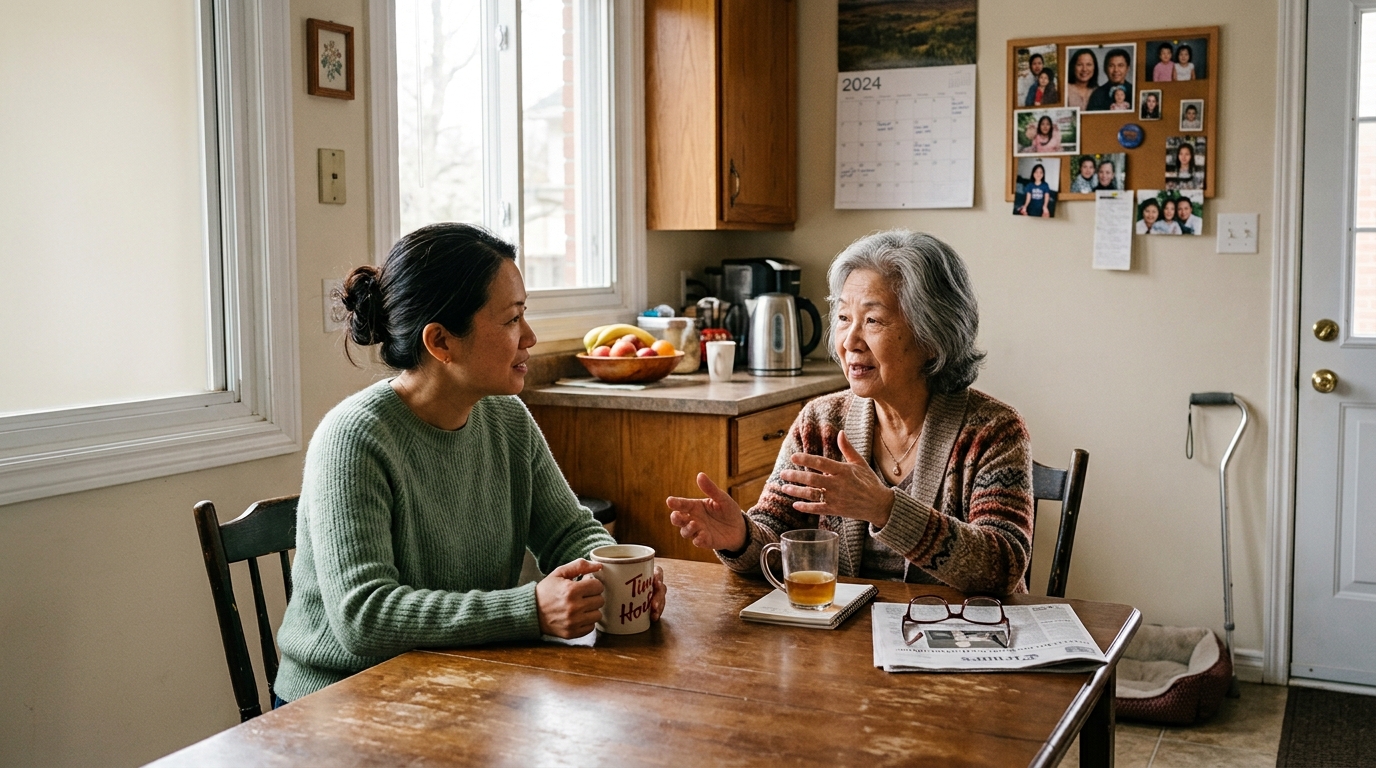
But when you bring up home care, they may immediately say:
"I don't need a caregiver."
For many older adults, the idea of receiving home care can feel like a loss of independence. They may worry that accepting help means they're no longer capable of living on their own.
That's why the conversation matters.
The goal isn't to convince your parent that they can't manage anymore. It's to understand what they need, respect their preferences, and explore whether some additional support could make everyday life easier and safer.
Why Parents May Resist Home Care
Before having the conversation, it helps to understand why your parent might be reluctant.
They may be concerned about:
- Losing their independence
- Having a stranger in their home
- Losing control over their daily routine
- The cost of care
- Privacy
- Being treated differently by family
- Feeling like they're becoming a burden
- Having to admit that they need help
- Giving up their home
- Being pushed toward a retirement home or long-term care
For some parents, "home care" may sound like a much bigger change than it actually is.
They may picture someone taking over their household or making decisions for them.
In reality, home care can be much more flexible. A Caregiver might come for only a few hours a week to help with specific tasks while the person continues to make their own decisions and live in their own home.
Learn more in How to Know When a Parent Needs Help at Home.
Start With Their Needs, Not the Word "Caregiver"
One of the easiest ways to make the conversation feel confrontational is to begin with:
"You need a caregiver."
Instead, start with what's actually happening.
For example:
- "You've mentioned that getting groceries has been difficult lately."
- "Would it help if someone came by to help with meals?"
- "You seem to be getting tired after doing the housework. Would some help around the house make things easier?"
- "Would you feel more comfortable having someone with you when you shower?"
- "How are you finding things since you came home from the hospital?"
These questions create a conversation rather than making an announcement.
You're not telling your parent what they need.
You're asking what they think would make their life easier.
Focus on What They Want to Keep Doing
Independence doesn't necessarily mean doing everything alone.
Sometimes, getting help with a few tasks can actually allow someone to remain independent in the areas that matter most to them.
For example, a parent might not be able to safely manage grocery shopping anymore but still want to cook.
A Caregiver could help with the shopping while your parent continues preparing meals.
Or your parent may need help getting dressed but still want to choose their own clothes and decide how they spend their day.
This distinction can change the entire conversation.
Instead of:
"You can't do this anymore."
Try:
"What would you like to keep doing, and where would having some help make things easier?"
That's a very different message.
Choose the Right Time to Talk
Don't wait until there's an emergency to bring up home care for the first time.
A fall, hospitalization, missed medication, or other crisis can force the family into making decisions quickly.
If you've started noticing changes, bring up the subject while everyone is calm.
Choose a time when:
- Your parent isn't tired or frustrated
- You have enough time for a proper conversation
- Other family members aren't arguing
- You're not dealing with an immediate crisis
- Your parent feels comfortable and in control
You may not resolve everything in one conversation.
That's okay.
Sometimes the first conversation is simply about opening the door.
Don't Make It About Age
Avoid statements like:
- "You're getting too old to do this."
- "You're not capable of living alone anymore."
- "People your age need help."
- "You can't keep doing this."
These statements can feel dismissive and can turn a practical conversation into an argument about independence.
Instead, focus on specific situations.
"The stairs seem to be getting harder for you."
is more productive than:
"You're getting too old for the stairs."
Specific observations give you something concrete to discuss.
Talk About Safety Without Creating Fear
Safety is important, but using fear as a negotiating tactic usually isn't helpful.
You don't need to tell your parent that something terrible is going to happen if they don't accept home care.
Instead, identify specific risks.
For example:
- Are they having difficulty getting in and out of the shower?
- Have they fallen recently?
- Are they struggling to prepare meals?
- Are they forgetting appointments?
- Are they having difficulty getting around the house?
- Are they becoming isolated?
- Are they having trouble managing everyday routines?
Then ask how they feel about those challenges.
"Would you feel safer if someone were here when you're showering?"
can be much more productive than:
"It's dangerous for you to shower alone."
Explain That Home Care Doesn't Mean Giving Up Independence
This may be the most important part of the conversation.
Your parent may hear "home care" and think:
"I'm losing my independence."
You can explain that the purpose of home care can be the opposite.
Getting help with certain tasks may allow them to continue living independently for longer.
A Caregiver might help with:
- Personal care
- Meals
- Household tasks
- Transportation
- Companionship
- Errands
- Mobility
- Daily routines
The person receiving care can still make decisions about their schedule, meals, activities, and home.
The Caregiver is there to provide support—not to take over the person's life.
Learn more in What Does Home Care Include?.
Start Small
Your parent may reject the idea of having someone come every day.
That doesn't necessarily mean they won't accept any help.
Consider starting small.
For example:
"What if someone came once a week to help with groceries and meal preparation?"
Or:
"Would you be comfortable trying someone for a couple of hours and seeing how it goes?"
Starting with a limited amount of support can make the idea feel much less overwhelming.
If the arrangement works well, additional support can be considered later.
And if something isn't working, you can adjust the arrangement.
Let Your Parent Have a Say in Who Comes Into the Home
For many people, the hardest part of home care isn't the care itself.
It's having another person in their home.
That's why giving your parent a voice in choosing their Caregiver can be important.
Depending on the provider, families may be able to consider factors such as:
- Experience
- Qualifications
- Availability
- Location
- Language
- Personality
- Communication style
- Experience with specific care needs
Vidal allows families to review Caregiver profiles and consider factors such as experience, qualifications, care needs, availability, location, language, and personality when looking for a good match.
This can help make the process feel more collaborative rather than something being imposed on your parent.
Learn more in How to Find a PSW for an Aging Parent.
Let Them Ask Questions
Your parent may have very practical concerns.
Be prepared to discuss questions such as:
"How much does it cost?"
"What exactly will they do?"
"Who is this person?"
"What if I don't like them?"
"How often will they come?"
"Do I have to have someone here every day?"
"Will they take over my house?"
These are reasonable questions.
Don't dismiss them.
The more control your parent feels they have over the arrangement, the easier it may be for them to consider trying it.
Talk About Cost Honestly
Cost can be a major concern, particularly when your parent has always managed their own finances.
Don't avoid the subject.
Private home care is generally charged based on the amount of care arranged, so the cost depends on factors such as the Caregiver's hourly rate, number of hours, and frequency of visits.
A few hours per week can be very different financially from daily or overnight care.
Learn more in How to Budget for Home Care for an Aging Parent.
If your parent may qualify for publicly funded home care, it's also worth understanding what services may be available through Ontario Health atHome. Eligibility and the amount of publicly funded support depend on an assessment of individual needs.
This can help separate the question of "Can we afford care?" from "What type and amount of care do we actually need?"
Don't Make It About the Whole Future
Another common mistake is trying to solve every future care decision at once.
Your parent may not be ready to discuss:
- Retirement homes
- Long-term care
- Future health changes
- End-of-life planning
- Increasing care needs
You may be thinking about all of these things.
They may only be thinking about how to get through the next few weeks.
That's okay.
Start with what is happening right now.
If your parent needs help after a hospital stay, focus on recovery.
If they're struggling with meals, focus on meals.
If they're lonely, talk about companionship.
If they're having trouble bathing safely, talk about personal care.
You don't have to solve the next five years in one conversation.
Use a Trial Period
If your parent is hesitant, suggest treating home care as a trial rather than a permanent decision.
For example:
"Let's try having someone come twice a week for a month. Then we'll see what you think."
This can make the decision feel reversible.
Your parent can meet the Caregiver, see how the arrangement feels, and decide whether it is useful.
A trial can also reveal something important: sometimes people who initially resist care discover that they actually enjoy having someone around.
The Caregiver may become someone they look forward to seeing rather than someone they feel they "need."
If Your Parent Says "I Don't Need Help"
Don't immediately argue.
Ask questions.
"What makes you feel like you don't need it?"
You may discover that your parent:
- Doesn't think their needs are serious enough
- Doesn't want strangers in the house
- Is worried about cost
- Thinks home care means losing independence
- Had a bad experience with a previous Caregiver
- Doesn't understand what home care actually involves
Once you know the reason for the resistance, you can address the actual concern.
If they're worried about having a stranger in the house, focus on choosing the right person.
If they're worried about cost, look at the numbers.
If they're worried about losing independence, explain that the goal is to support independence.
If they simply don't think they need help, focus on specific situations rather than arguing about whether they're "old enough" for care.
If Your Parent Still Says No
Sometimes, the answer will still be no.
If your parent is capable of making their own decisions, you may not be able to force them to accept home care simply because you believe it would help.
In that situation, continuing to argue may make the issue worse.
Instead, keep the conversation open.
You can say:
"I understand that you don't want anyone coming right now. If things change, let's talk about it again."
You can also work on practical ways to reduce risk in the meantime.
For example:
- Arrange regular family check-ins
- Improve lighting around the home
- Address trip hazards
- Arrange grocery delivery
- Set up transportation
- Organize meals
- Consider an emergency response system
- Stay alert to changes in mobility or cognition
If there is an immediate safety concern or your parent is no longer able to make informed decisions about their care, the situation may require professional assessment rather than simply another family conversation.
What If Your Parent Needs More Care Than the Family Can Provide?
Sometimes the conversation starts because the family has already reached its limit.
A daughter may be visiting every evening after work.
A son may be driving across town several times a week.
A spouse may be providing care throughout the night.
Eventually, the family may realize that the current arrangement isn't sustainable.
This is an important point to acknowledge.
Family support is valuable, but family members don't have to provide every hour of care themselves.
Professional home care can fill gaps and provide respite, allowing family members to remain involved without becoming the only source of care.
Learn more in How Many Hours of Home Care Does a Senior Need?.
What If Your Parent Is Recovering From a Hospital Stay?
The conversation can sometimes be easier when there is a clear, temporary reason for additional support.
For example:
"Let's get someone to help you for the first few weeks while you're recovering."
This can feel less like an admission that your parent has permanently lost independence.
Post-hospital home care can help with personal care, mobility, meals, companionship, and everyday tasks while someone gets back on their feet.
Learn more in Home Care After Hospital Discharge.
How Vidal Can Help
Once your parent is open to the idea of home care, the next challenge is finding someone who is a good fit.
Vidal gives families the ability to review Caregiver profiles and consider factors such as experience, qualifications, availability, location, language, personality, and care needs.
Vidal Caregivers are PSWs who go through structured screening, including identity verification, certification verification, background screening, a video assessment, and a knowledge and standards test.
Families can also work with Vidal's Care Coordination team for support navigating the process.
The goal is not simply to find someone who is available.
It's to find someone your parent can feel comfortable welcoming into their home.
Learn more in What Questions Should You Ask When Hiring a PSW?.
A Simple Way to Start the Conversation
If you're not sure what to say, keep it simple.
You don't need a speech.
You could start with:
"I've noticed that some things have been getting harder for you lately. I don't want to take away your independence, but I was wondering if having someone help with a few things would make life easier. What do you think?"
Then listen.
You may not get an immediate yes.
That's okay.
The goal of the first conversation isn't necessarily to arrange care.
It's to make it possible to talk about care without your parent feeling that their independence is being taken away.
FAQ
Frequently asked questions
The Bottom Line
Talking to a parent about home care is rarely just a conversation about hiring a Caregiver.
It's a conversation about independence, privacy, safety, and control.
The most productive approach is usually not to tell your parent what they need.
Instead:
- Start with specific concerns
- Listen to their perspective
- Focus on what they want to keep doing
- Explain that home care can be flexible
- Start with a small amount of help if appropriate
- Involve them in choosing their Caregiver
- Be honest about cost
- Consider a trial period
- Keep the conversation open if they're not ready
Most importantly, remember that asking for help doesn't have to mean giving up independence.
Sometimes, the right support is exactly what allows someone to keep living the life they want, in the home they want, for longer.
Looking for the right support for your loved one?
Tell us what your loved one needs at home. Compare qualified Caregivers.
And choose someone who feels like the right fit.
Free, no-obligation conversation.