
Home Care Basics
What Is a Personal Support Worker (PSW)?
If you’re helping an aging parent, spouse, or loved one stay at home, you’ve probably come across the term PSW, or Personal Support Worker.
But what does a PSW actually do? What kind of training do they have? How is a PSW different from a nurse or other healthcare professional? And when does someone actually need one?
A Personal Support Worker provides hands-on support with everyday activities, personal care, mobility, companionship, and other routines that can become difficult because of aging, illness, injury, disability, or reduced independence.
For many families, a PSW can be the difference between struggling to manage everything alone and having the right amount of support to make staying at home more manageable.
Last updated:
What Is a Personal Support Worker?
A Personal Support Worker (PSW) is a trained care professional who helps people with everyday personal care and daily living activities.
PSWs commonly work with:
- Older adults aging at home
- People living with dementia or Alzheimer's disease
- People with mobility limitations
- Adults recovering from illness, injury, or surgery
- People living with chronic conditions or disabilities
- Individuals who need temporary or ongoing assistance at home
Ontario describes PSWs as providing personal care, companionship, and support with activities of daily living. PSWs may work in people's homes, long-term care, or other care settings.
The important thing to understand is that a PSW is not a nurse. PSWs focus primarily on personal support and everyday care, while nurses have a different scope of practice, education, and clinical responsibilities. Ontario specifically describes PSWs in long-term care as staff who provide personal care but are not nurses.
For many families, though, the support a PSW provides is exactly what is needed to help someone remain safe, comfortable, and independent at home.
What Does a PSW Do?
The exact responsibilities of a PSW depend on the person's needs, the care setting, and the employer or provider.
At home, PSW support can include several different types of assistance.
Personal Care
This is one of the most common reasons families arrange PSW care.
A PSW may help with:
- Bathing and showering
- Dressing
- Grooming
- Toileting
- Continence care
- Personal hygiene
- Getting ready in the morning or preparing for bed
These tasks can be very personal. A good PSW should provide assistance in a way that protects the person's privacy, dignity, and independence.
Mobility and Transfers
A PSW may also help someone move safely around their home.
This can include:
- Getting in and out of bed
- Moving between a bed and chair
- Walking around the home
- Assistance with mobility routines
- Transfers between surfaces
The appropriate level of assistance depends on the person's abilities and care plan.
Meals and Mealtime Support
A PSW can help with everyday nutrition-related routines, such as:
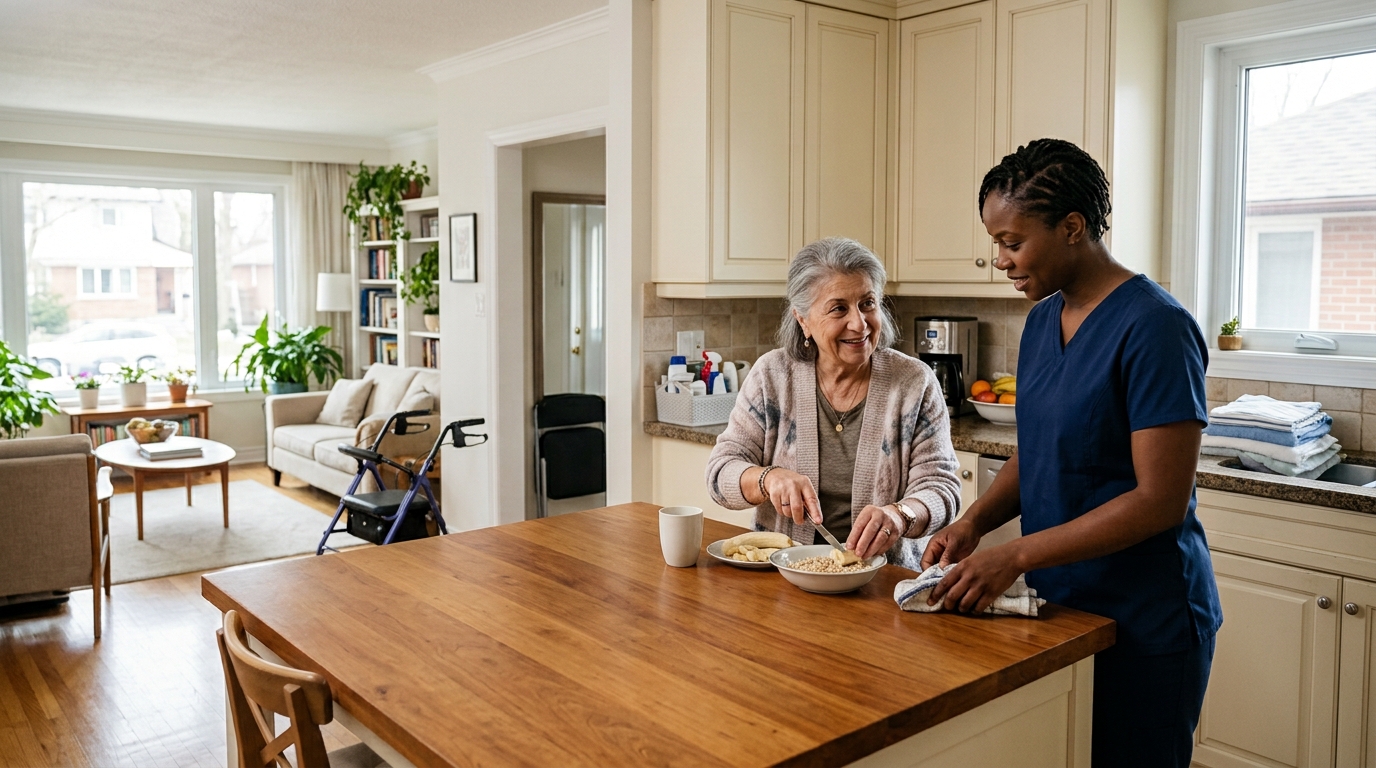
- Preparing simple meals
- Setting up meals
- Helping someone eat or drink when assistance is needed
- Cleaning up after meals
For someone who has difficulty preparing food independently, even a few hours of support can make a meaningful difference.
Companionship
PSW care isn't only about physical tasks.
A PSW may spend time talking with a client, going for a walk, playing a game, helping with an activity, or simply providing company.
For an older adult who spends much of the day alone, companionship can be an important part of remaining connected and engaged.
Medication Reminders
Depending on the care arrangement and the tasks permitted, a PSW may provide reminders to take medications according to an established routine.
This is different from prescribing medications or making clinical decisions about them.
Light Household Support
Some home care arrangements can also include everyday household tasks related to the person's care, such as:
- Light housekeeping
- Laundry
- Meal preparation
- Tidying the immediate living area
The purpose isn't to provide a general cleaning service. These tasks are typically connected to helping the person function safely and comfortably at home.
Ontario Health atHome similarly describes personal support as assistance with daily activities such as hygiene, bathing, dressing, and eating, with homemaking services sometimes provided alongside personal support.
What a PSW Does Not Do
One of the most important things to understand when arranging care is that PSWs and nurses have different roles.
A PSW generally does not replace a:
- Registered Nurse (RN)
- Registered Practical Nurse (RPN)
- Doctor
- Physiotherapist
- Occupational Therapist
- Other regulated healthcare professional
For example, if your loved one needs nursing care, wound assessment, clinical monitoring, medication management that requires a regulated professional, or another specialized clinical service, a PSW may not be the appropriate professional to provide it.
That doesn't mean a PSW can't be part of the overall care team.
In fact, many people receive different types of care at the same time. Ontario Health atHome, for example, coordinates services that can include nursing, physiotherapy, occupational therapy, social work, and personal support.
What Training Does a PSW Have?
PSW education in Ontario includes classroom education and practical or clinical experience.
Ontario says PSW certificate programs are offered through publicly assisted colleges, career colleges, and district school boards, among other educational pathways.
Training generally prepares PSWs to support people with:
- Personal care
- Activities of daily living
- Mobility
- Safety
- Communication
- Dementia and other care needs
- Basic health and wellbeing support
- Professional boundaries and privacy
However, being a certified PSW doesn't automatically mean someone is the right PSW for every situation.
Experience matters.
Someone caring for a person with advanced dementia, for example, may benefit from a Caregiver with specific dementia experience. Someone recovering from surgery may need someone comfortable with mobility and transfers.
That's why families should look beyond the letters "PSW" and consider the person's actual experience and qualifications. For more guidance, see What Questions Should You Ask When Hiring a PSW?.
Are All PSWs the Same?
No.
Two people can both be qualified PSWs and have very different experience, personalities, communication styles, and areas of expertise.
For example, one PSW might have extensive experience with:
- Dementia care
- Parkinson's disease
- Mobility assistance
- Palliative care
Another might have more experience with:
- Post-hospital recovery
- Companionship
- Personal care
- Supporting relatively independent seniors
Additional training can also matter.
At Vidal, Caregivers are certified PSWs, and some have additional training or qualifications in areas such as dementia-related approaches, palliative care, medication assistance, falls prevention, lift and transfer support, continence care, Parkinson's care, and other specialized areas. For more guidance, see How to Find a PSW for an Aging Parent.
When Should You Consider Hiring a PSW?
There isn't one specific point at which someone "needs" a PSW.
Sometimes the need is obvious. Other times, it starts with small changes.
You might consider PSW support if your loved one is:
- Struggling to bathe or dress independently
- Having difficulty getting around safely
- Forgetting meals or having trouble preparing food
- Having difficulty managing everyday routines
- Spending long periods alone
- Recovering from a hospital stay or surgery
- Living with dementia or another condition that affects daily activities
- Putting increasing demands on a family caregiver
- No longer managing safely at home without assistance
The question isn't necessarily whether your parent needs full-time care.
It may simply be whether a few hours of the right support could make life safer and easier. For more guidance, see How to Know When a Parent Needs Help at Home.
How Many Hours of PSW Care Does Someone Need?
It depends entirely on the person's situation.
Someone may need:
- A few hours per week
- Help with a morning routine
- Several visits throughout the week
- Daily support
- Evening or overnight assistance
- More intensive care during a period of recovery
Care needs can also change.
Someone might need only occasional assistance after returning home from the hospital, then gradually require less support as they recover.
Another person may need increasing assistance as a chronic condition progresses.
The goal should be to arrange the amount of support that actually fits the person's needs, rather than automatically assuming that more hours are better.
What Is the Difference Between a PSW and a Caregiver?
You'll often hear the words PSW and Caregiver used interchangeably, but they aren't necessarily the same thing.
"Caregiver" is a broader term. It can refer to someone who provides care to another person, including a family member, companion, or professional care worker.
A PSW is specifically a trained personal support worker.
For families comparing home care options, it's worth asking whether the person providing care is actually a certified PSW and what experience they have.
At Vidal, every Caregiver must be a certified PSW who has completed the required certification verification process. Vidal also verifies identity, First Aid/CPR certification, and conducts background screening including a Vulnerable Sector Check.
What Is the Difference Between a PSW and a Nurse?
This is another common question.
The simplest distinction is:
PSWs provide personal support and assistance with everyday activities. Nurses provide regulated nursing care and have a broader clinical scope of practice.
For example, a PSW might help someone shower, get dressed, prepare a meal, move safely around the home, or maintain a daily routine.
A nurse may assess a medical condition, provide nursing interventions, monitor clinical changes, or perform other duties within their regulated scope.
They can work together as part of a person's overall care.
If you're unsure which type of professional your loved one needs, it can be helpful to start by identifying the specific tasks and challenges they are having at home. For a fuller comparison of the two roles, see PSW vs. Nurse: What's the Difference?. For more guidance, see How to Choose the Right Home Care for a Loved One.
Can a PSW Help Someone With Dementia?
Yes. PSWs can play an important role in supporting people living with dementia.
Support may include:
- Personal care
- Meals
- Mobility
- Companionship
- Familiar routines
- Assistance with everyday activities
- Supervision and reassurance
But dementia care isn't simply about completing a list of tasks.
The right personality, communication style, patience, and experience can make a significant difference.
A person living with dementia may be much more comfortable with someone who understands their routines and knows how to communicate with them. For more guidance, see Home Care for Seniors With Dementia.
What Should You Look for in a PSW?
Qualifications are important, but they are only part of the decision.
When choosing a PSW, consider:
1. Training and certifications
Confirm that the person has the appropriate PSW education and current certifications required for the care arrangement.
2. Relevant experience
Look for experience that matches your loved one's needs.
3. Personality and communication
Your parent may spend several hours with this person. A good personality fit matters.
4. Availability
Make sure their availability actually matches the schedule you need.
5. Language
For some families, having a PSW who speaks the same language as the person receiving care can make communication significantly easier.
6. Specialized experience
If your loved one has dementia, Parkinson's, mobility limitations, or another specific need, ask about relevant experience or additional training.
7. Trust and screening
You're inviting someone into your loved one's home. Understanding how the PSW has been screened and what credentials have been verified is important. For more guidance, see Private PSW vs. Home Care Agency: What's the Difference?.
How Vidal Approaches PSW Care
Vidal takes a different approach to finding home care.
Instead of simply assigning a PSW based on availability, families can review Caregiver profiles and consider factors such as experience, qualifications, care needs, availability, language, personality, and communication style.
Every Vidal Caregiver is a certified PSW and goes through a structured screening process that includes identity verification, certification verification, background and Vulnerable Sector screening, a video assessment, and a knowledge and standards test.
That gives families something between the traditional agency model and completely arranging care on their own:
More choice than a traditional agency, with more support than hiring completely on your own.
The goal isn't simply to find a PSW who is available.
It's to find someone who is qualified and feels like the right fit for the person receiving care. For more guidance, see How Much Does a PSW Cost in Toronto?.
How Much Does a PSW Cost?
The cost of private PSW care depends on several factors, including the provider, the caregiver's experience, the type of care required, the schedule, and the minimum visit length.
In Toronto, traditional home care agencies commonly charge around $35–$50+ per hour, although rates vary. Minimum visit requirements can also have a major effect on the total cost.
With Vidal, Caregivers set their own rates, and families can compare Caregivers based on factors including experience, availability, and hourly rate. Vidal's current model allows requests starting at one hour, subject to Caregiver availability and acceptance.
The important thing is to compare the total cost of the care you actually need, rather than looking only at the hourly rate. For more guidance, see How to Budget for Home Care for an Aging Parent.
Can a PSW Help a Family Caregiver?
Absolutely.
Hiring a PSW doesn't necessarily mean the family is stepping away from caregiving.
Often, it means family members can continue being involved without having to handle every personal care task themselves.
A PSW might provide support while a family member:
- Goes to work
- Runs errands
- Attends appointments
- Takes care of children
- Gets some rest
- Takes a short break
- Simply has time away from caregiving responsibilities
This type of support is often called respite care.
What If You Only Need a PSW Temporarily?
PSW care doesn't have to be permanent. Learn more in Home Care After a Hospital Discharge.
Temporary support can make sense after:
- A hospital stay
- Surgery
- An illness or injury
- A fall
- A change in mobility
- A period when the usual family caregiver is unavailable
You can reassess the situation as your loved one's needs change.
Some people eventually need less support. Others discover that continuing home care helps them remain safely at home for longer.
Questions to Ask Before Hiring a PSW
Before choosing someone, make sure you understand:
- What training and certifications do they have?
- How much experience do they have?
- Have they cared for someone with similar needs?
- What days and times are they available?
- What tasks can they help with?
- What is their hourly rate?
- Is there a minimum visit length?
- What happens if they become unavailable?
- How are credentials and background checks verified?
- Do they seem like someone your loved one will be comfortable with?
And don't underestimate the last question.
A PSW can have excellent qualifications and still not be the right match for your parent. For more guidance, see What Questions Should You Ask When Hiring a PSW?.
FAQ
Frequently asked questions
The Bottom Line
A Personal Support Worker can provide practical, hands-on support that helps someone continue living safely and comfortably at home.
But finding a PSW isn't just about finding someone with the right certificate.
The best match also needs to fit the person's care needs, routines, personality, preferences, and schedule.
For families, that means the right questions are not simply:
"Do we need a PSW?"
They're also:
"What do we actually need help with?"
"What type of experience does the person providing care need?"
And:
"Who will be the right fit for our loved one?"
Those answers can help you determine whether PSW care is appropriate, how much support you need, and what kind of Caregiver to look for.
Vidal gives families a way to browse certified, screened PSWs, compare their experience and qualifications, and choose a Caregiver based on what matters to their family—while still having Care Coordination support when they need it.
Looking for the right PSW for your loved one?
Tell us what your loved one needs at home. Compare qualified Caregivers.
And choose someone who feels like the right fit.
Free, no-obligation conversation.