
Home Care Basics
What Can a PSW Help With at Home?
When a parent or loved one begins struggling with everyday tasks, families often know they need some help—but aren't always sure what a Personal Support Worker (PSW) can actually do at home.
Can a PSW help with bathing? Meals? Getting out of bed? Dementia care? Housework? Medication? What about companionship?
The answer is that PSW support can cover many parts of everyday life, but the exact responsibilities depend on the person's needs, the care arrangement, and what the PSW is trained and permitted to do.
The goal isn't to take over everything.
For many families, it's to provide just enough support to help a loved one remain safe, comfortable, independent, and at home.
Last updated:
What Can a PSW Help With?
A PSW can provide support with many activities of daily living, including:
- Personal hygiene and bathing
- Dressing and grooming
- Toileting and continence care
- Mobility and transfers
- Getting in and out of bed
- Meal preparation and mealtime support
- Medication reminders
- Companionship
- Dementia and memory support
- Light housekeeping related to the person's care
- Laundry
- Respite for family caregivers
- Support with everyday routines
Ontario Health atHome describes personal support as assistance with daily personal care and activities of daily living, including bathing, dressing, eating, transferring, and other forms of support.
But there is an important distinction:
A PSW is there to support the person—not simply to do everything for them.
Good home care should encourage as much independence as is safely possible.
1. Bathing and Personal Hygiene
Personal care is one of the most common reasons families arrange PSW support.
For a broader look at the role, see What Is a Personal Support Worker?.
A PSW may help with:
- Bathing or showering
- Washing
- Grooming
- Oral hygiene
- Dressing
- Undressing
- Toileting
- Continence care
For someone who is physically unable to manage these tasks independently, having help can make a major difference.
It can also reduce the risk of falls or other problems that can occur when someone tries to manage a difficult task alone.
Personal care can be particularly sensitive for older adults who are accustomed to doing everything themselves.
A good PSW should provide assistance respectfully, while allowing the person to do whatever they can safely manage on their own.
2. Getting Dressed and Ready for the Day
Something as simple as getting dressed can become difficult because of:
- Reduced mobility
- Arthritis
- Weakness
- Balance problems
- Cognitive changes
- Recovery from illness or surgery
A PSW can help someone get dressed, choose appropriate clothing, put on footwear, and complete their morning routine.
For many families, this is particularly useful because morning care can be one of the most demanding parts of the day.
The goal isn't necessarily for the PSW to do everything.
They may simply provide the assistance needed for the person to complete the routine safely.
3. Toileting and Continence Care
A PSW may assist with toileting and continence-related routines.
This can include helping someone:
- Get to and from the bathroom
- Transfer safely
- Manage personal hygiene
- Change continence products
- Maintain a regular bathroom routine
These needs can be especially important for someone with limited mobility or dementia.
Because this type of care is highly personal, trust and compatibility between the Caregiver and client matter.
4. Getting In and Out of Bed
A person may be relatively independent during the day but still need help getting in or out of bed.
A PSW may provide assistance with:
- Getting up in the morning
- Getting into bed at night
- Moving between the bed and a chair
- Repositioning
- Establishing a safe morning or nighttime routine
Vidal's personal care services specifically include support with getting in and out of bed, moving around the home, and transferring safely between surfaces.
For nighttime support, see Overnight Home Care: What Families Should Know.
5. Mobility and Transfers
Mobility support can mean different things for different people.
A PSW might help someone:
- Walk safely around the home
- Move from a bed to a chair
- Transfer between surfaces
- Use mobility equipment as appropriate
- Move safely to the bathroom or dining area
- Maintain an established mobility routine
The appropriate level of assistance depends on the person's abilities and the Caregiver's training.
Families should be specific about mobility needs when arranging care.
Someone who simply needs an arm for stability is very different from someone who requires significant assistance with transfers.
6. Meal Preparation and Mealtime Support
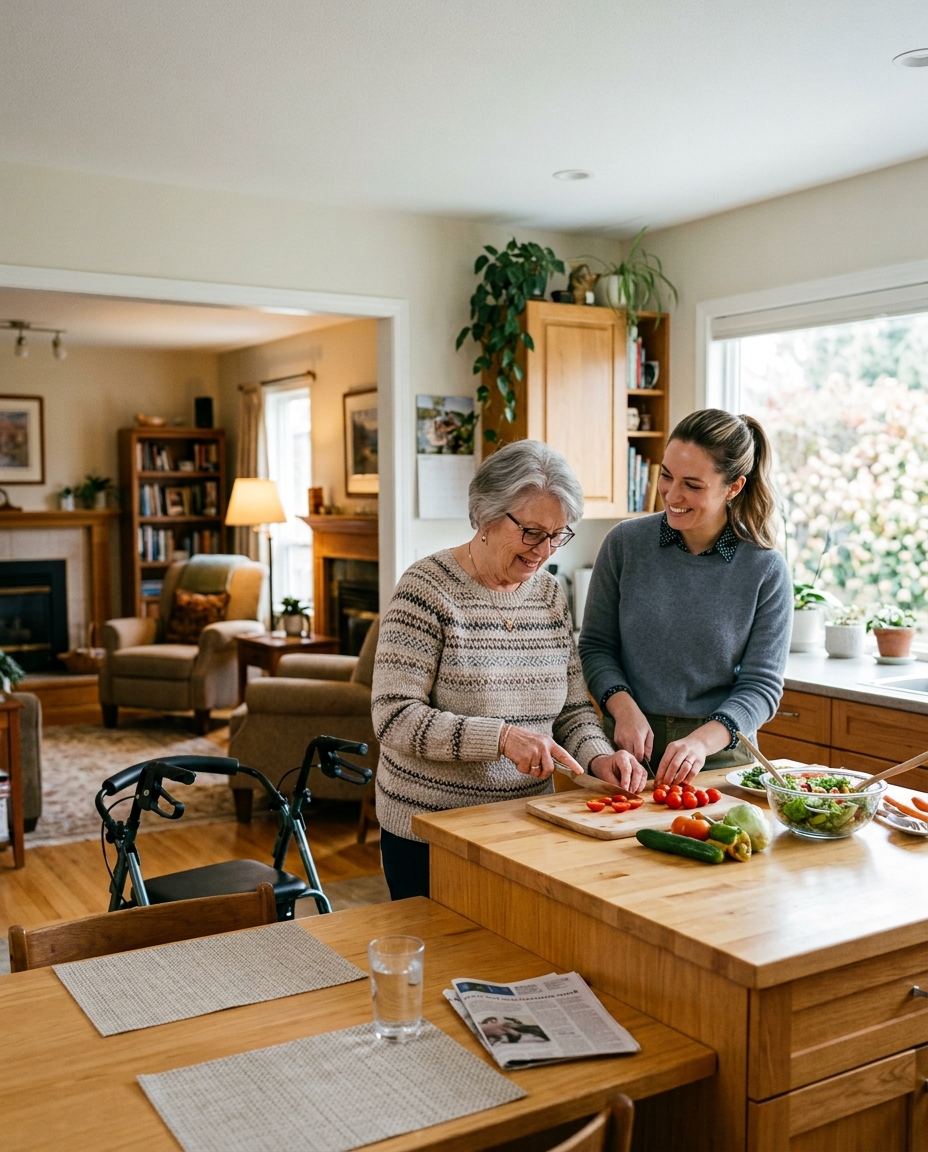
A PSW can also help make meals part of a person's regular routine.
This may include:
- Preparing simple meals
- Preparing snacks
- Setting up meals
- Helping someone eat or drink when assistance is needed
- Cleaning up after meals
- Encouraging regular meals and hydration
Vidal includes meal preparation and mealtime assistance among its personal care services.
For an older adult who is capable of eating independently but no longer able to safely prepare meals, meal preparation alone may be enough to make a meaningful difference.
Small changes in daily routines can be a sign that support is needed. See How to Know When a Parent Needs Help at Home.
7. Medication Reminders
A PSW may be able to provide medication reminders according to an established routine.
For example, a Caregiver might remind someone that it is time to take their medication.
This is different from:
- Prescribing medication
- Changing a medication schedule
- Deciding which medication someone should take
- Providing clinical medication management
If your loved one's medication needs are more complex, ask specifically what type of professional support is required.
Vidal lists medication reminders as one of the services that may be included in personal care.
8. Companionship
Home care isn't only about physical tasks.
A PSW can also provide companionship by:
- Talking with the client
- Having a cup of tea together
- Playing cards or games
- Looking through photographs
- Reading
- Going for a walk
- Participating in familiar activities
- Providing company during the day
For someone who lives alone, this can be just as important as help with bathing or meals.
The right Caregiver can become a familiar and reassuring part of someone's routine.
This is particularly important for people living with dementia, where familiarity and consistency can help make everyday care more comfortable.
Learn more in Home Care for Seniors With Dementia.
9. Dementia and Memory Support
PSWs can provide valuable day-to-day support for someone living with dementia.
This may include:
- Assistance with personal care
- Meal preparation
- Mobility support
- Companionship
- Help maintaining familiar routines
- Reassurance
- Assistance with everyday activities
But dementia care requires more than simply completing tasks.
Communication style, patience, personality, and experience can all matter.
For guidance on assessing these qualities, see What Questions Should You Ask When Hiring a PSW?.
For some families, finding a Caregiver who understands their loved one's particular routines and preferences is just as important as finding someone with the right technical qualifications.
10. Light Housekeeping and Laundry
Some PSW care arrangements can include light household tasks that are connected to the person's care.
For example:
- Laundry
- Tidying the person's immediate living area
- Changing bedding
- Cleaning up after meal preparation
- Keeping the environment safe and comfortable
This is different from hiring a general house cleaner.
The purpose of these tasks is to support the person's ability to live safely and comfortably at home.
Ontario Health atHome distinguishes personal support from broader housekeeping and notes that homemaking services such as light housekeeping or laundry may be provided alongside personal support in certain publicly funded arrangements.
What is included can depend on the care arrangement. See Private PSW vs. Home Care Agency: What's the Difference?.
11. Respite for Family Caregivers
A PSW can also provide support that gives a family caregiver a break.
For example, a daughter who normally stays with her mother might arrange a PSW for several hours so she can:
- Go to work
- Run errands
- Attend an appointment
- Spend time with her own children
- Get some rest
- Leave the house
- Simply have time away from caregiving
Ontario Health atHome recognizes respite as one of the potential roles of personal support services.
Respite doesn't mean the family is abandoning its caregiving role.
It can make that role more sustainable.
12. Support After a Hospital Stay
Someone returning home after surgery, an illness, or an injury may temporarily need help with tasks they normally handle independently.
Learn more in Home Care After Hospital Discharge.
A PSW can potentially help with:
- Personal care
- Getting around the home
- Meals
- Transfers
- Daily routines
- Companionship
- Household tasks related to care
The amount of help may decrease as the person recovers.
This is one reason flexible home care can be useful: the amount of support someone needs today may not be the amount they need six weeks from now.
13. Support With Everyday Routines
Sometimes the need isn't one specific task.
A parent may simply have difficulty getting through the day independently.
A PSW can help create structure around routines such as:
Morning: Getting out of bed → toileting → bathing → dressing → breakfast
Afternoon: Lunch → medication reminder → activity → walk → companionship
Evening: Dinner → personal care → changing into pajamas → getting ready for bed
The PSW becomes part of the person's routine rather than simply arriving to complete a checklist of tasks.
That can be particularly valuable for people who benefit from familiarity and consistency.
What Can't a PSW Help With?
Understanding the limits of PSW care is just as important as understanding what a PSW can do.
A PSW is not a replacement for every healthcare professional or home service.
Depending on the situation, a PSW may not be able to:
- Diagnose a medical condition
- Prescribe medication
- Change a treatment plan
- Provide services outside their training or scope
- Perform heavy housekeeping
- Perform home maintenance or repairs
- Provide transportation where they are not trained or insured to do so
- Replace nursing or other regulated healthcare services
For example, Ontario Health atHome notes that certain PSW programs do not include heavy housekeeping, home maintenance, transportation of patients in a vehicle, or attending medical appointments in place of a caregiver.
The exact boundaries depend on the care arrangement, the provider, and the PSW's training.
If you're unsure, ask before arranging care.
Does a PSW Do Everything for the Person?
Not necessarily—and ideally, they shouldn't if the person can safely do something themselves.
One of the goals of good home care is to support independence rather than unnecessarily replace it.
For example, if your mother can dress herself but struggles with buttons, a PSW might help with the difficult parts rather than dressing her completely.
If your father can prepare a sandwich but struggles to stand for long periods, the PSW might prepare the ingredients and let him participate.
This approach can help preserve:
- Independence
- Confidence
- Familiar routines
- Physical abilities
- A sense of control
The right amount of help is often the least amount of assistance needed to make the task safe and manageable.
How Much PSW Help Does Someone Need?
There isn't a universal answer.
Someone might need:
- Two hours once a week
- A few visits each week
- Daily morning assistance
- Daily morning and evening care
- Overnight support
- Temporary help after hospitalization
- More extensive ongoing support
Start with the tasks that are actually causing difficulty.
Ask:
- What can my loved one no longer do safely?
- What can they still do independently?
- What tasks are creating the most stress?
- What is the family currently doing?
- Which parts could a PSW realistically take over?
For help planning the cost, see How to Budget for Home Care for an Aging Parent.
This can help you determine whether you need a few hours of targeted assistance or something more substantial.
Does the PSW Need Special Experience?
Sometimes.
A general PSW may be appropriate for someone who primarily needs help with bathing, dressing, meals, and companionship.
But specialized needs may call for someone with relevant experience or additional training.
For example:
- Dementia
- Parkinson's disease
- Mobility limitations
- Palliative or end-of-life care
- Falls risk
- Transfers
- Continence care
Vidal allows families to consider Caregiver experience, qualifications, availability, language, personality, and communication style when looking for a match. Some Vidal Caregivers also have additional training in specialized areas.
The important question isn't simply:
"Is this person a PSW?"
It's:
"Is this the right PSW for what my loved one needs?"
Learn more in How to Find a PSW for an Aging Parent.
How Vidal Can Help
Families don't always need someone to provide every type of care.
They may need someone who can help with a very specific combination of tasks—and who is also a good personality fit for their loved one.
Vidal connects families with certified PSW Caregivers who provide one-on-one support based on a person's needs, preferences, routines, and level of independence.
Families can review Caregiver options and consider factors such as experience, availability, rates, and approach to care.
For pricing guidance, see How Much Does a PSW Cost in Toronto?.
Vidal Caregivers are also screened and certified PSWs, giving families additional support when arranging private home care.
The result is a more flexible approach: choose the Caregiver who fits your family, arrange the amount of support you actually need, and have coordination support when you need it.
A Simple Way to Think About PSW Support
If you're trying to figure out what a PSW can help with, don't start by asking:
"What services does a PSW provide?"
Start with:
"What is becoming difficult for my loved one?"
Maybe it's the morning shower.
Maybe it's getting dressed.
Maybe it's preparing meals.
Maybe it's getting safely from the bedroom to the bathroom.
Maybe it's loneliness.
Maybe it's everything that happens between getting out of bed and getting back into it at night.
Once you identify the actual challenges, it becomes much easier to determine what type and amount of support would be useful.
FAQ
Frequently asked questions
The Bottom Line
A PSW can help with much more than bathing and dressing.
Depending on the person's needs and the care arrangement, support can include personal care, mobility, meals, medication reminders, companionship, dementia support, light household tasks, respite, and everyday routines.
But the goal isn't to take away someone's independence.
It's to provide the right assistance where it's needed so they can continue doing as much as possible for themselves.
For families, that means the best PSW isn't necessarily the person who can do the most.
It's the person who can provide the right kind of help, in the right way, at the right time.
Looking for the right PSW for your loved one?
Tell us what your loved one needs at home. Compare qualified Caregivers.
And choose someone who feels like the right fit.
Free, no-obligation conversation.