
Home Care Guides
How to Know If an Aging Parent Shouldn't Live Alone
Knowing when an aging parent should no longer live alone can be one of the hardest decisions a family has to make.
For many older adults, staying at home represents independence, familiarity, and control over their daily life. Wanting to remain at home does not necessarily mean they need to move somewhere else.
Last updated:
The more important question is:
Can your parent safely and reliably manage daily life at home, with the right level of support?
Sometimes the answer is yes. Sometimes a few hours of help each week can make living alone safer and more manageable. In other situations, the level of support needed may be greater.
Here are some of the signs families should watch for.
Signs an Aging Parent May Not Be Safe Living Alone
There is rarely one single event that tells a family it is time for a change.
Instead, concerns often appear gradually.
1. Falls Are Becoming More Frequent
An occasional stumble may not necessarily mean someone cannot live alone.
But repeated falls, unexplained injuries, difficulty getting up after a fall, or increasing difficulty walking around the home can be warning signs.
Pay attention to whether your parent is:
- Having more frequent falls or near-falls
- Using furniture or walls for support
- Struggling with stairs
- Having difficulty getting in and out of bed or chairs
- Avoiding certain rooms because they are difficult to reach
- Having trouble getting into or out of the shower or bathtub
A parent who has become less steady may need additional support with mobility, transfers, bathing, or other daily routines.
2. Personal Hygiene Is Changing
Changes in personal hygiene can sometimes be an early indication that everyday tasks are becoming difficult.
You may notice that your parent is:
- Wearing the same clothes repeatedly
- Showering or bathing less often
- Having difficulty grooming
- Struggling with toileting
- Wearing soiled clothing
- Avoiding personal care routines they previously managed independently
These changes are not necessarily about unwillingness.
Sometimes a task that used to be easy has simply become physically or cognitively difficult. A PSW can assist with bathing, dressing, grooming, toileting, mobility, and other daily activities — learn more in What Can a PSW Help With at Home?
3. Your Parent Is Forgetting Important Things
Occasional forgetfulness is common as people age. More concerning is a noticeable change that begins to affect everyday safety.
For example, your parent may:
- Forget to turn off the stove
- Leave doors unlocked
- Forget appointments repeatedly
- Miss meals
- Take medications incorrectly
- Become confused about the day or time
- Get lost in familiar places
- Forget important household routines
- Repeat the same questions or stories frequently
If these changes are becoming more frequent, it is worth discussing them with your parent's healthcare provider.
If dementia is involved, familiar routines and consistent support can become particularly important. Learn more in Home Care for Seniors With Dementia.
4. Meals Are Becoming a Problem
Look at what is actually happening in the kitchen.
Is your parent still eating regular meals? Are there fresh groceries in the house? Are they able to prepare food safely?
Warning signs can include:
- Spoiled food in the refrigerator
- Unopened groceries accumulating
- Frequent skipped meals
- Significant changes in eating habits
- Difficulty preparing familiar foods
- Leaving the stove or oven on
- Relying almost entirely on snacks or prepared foods
A parent does not necessarily need to stop living alone simply because cooking has become difficult.
Meal preparation, grocery support, companionship, and other forms of home care may help bridge that gap.
5. Medication Management Is Becoming Difficult
Medication mistakes can create serious problems.
A parent who used to manage medications independently may begin forgetting doses, taking medication more than once, or becoming confused about what they are supposed to take.
If medication management is becoming unreliable, talk with their healthcare provider about appropriate solutions.
Depending on the situation, additional home support may also be appropriate.
Medication-related assistance can vary depending on the Caregiver's training and the care arrangement, so families should clarify exactly what support is available rather than assuming every PSW can perform the same tasks.
6. The House Is Becoming Increasingly Unsafe or Unmanageable
Sometimes the clearest signs are visible around the home.
Look for:
- Increasing clutter
- Laundry piling up
- Unwashed dishes
- Spoiled food
- Tripping hazards
- Unexplained damage around the house
- Burn marks from cooking
- Appliances being left on
- Difficulty managing garbage or basic household routines
A decline in housekeeping alone does not necessarily mean someone cannot live alone.
But when household problems appear alongside falls, memory problems, poor nutrition, or difficulty with personal care, the overall picture becomes more concerning.
Practical help at home can take many forms — learn more in What Does Home Care Include?
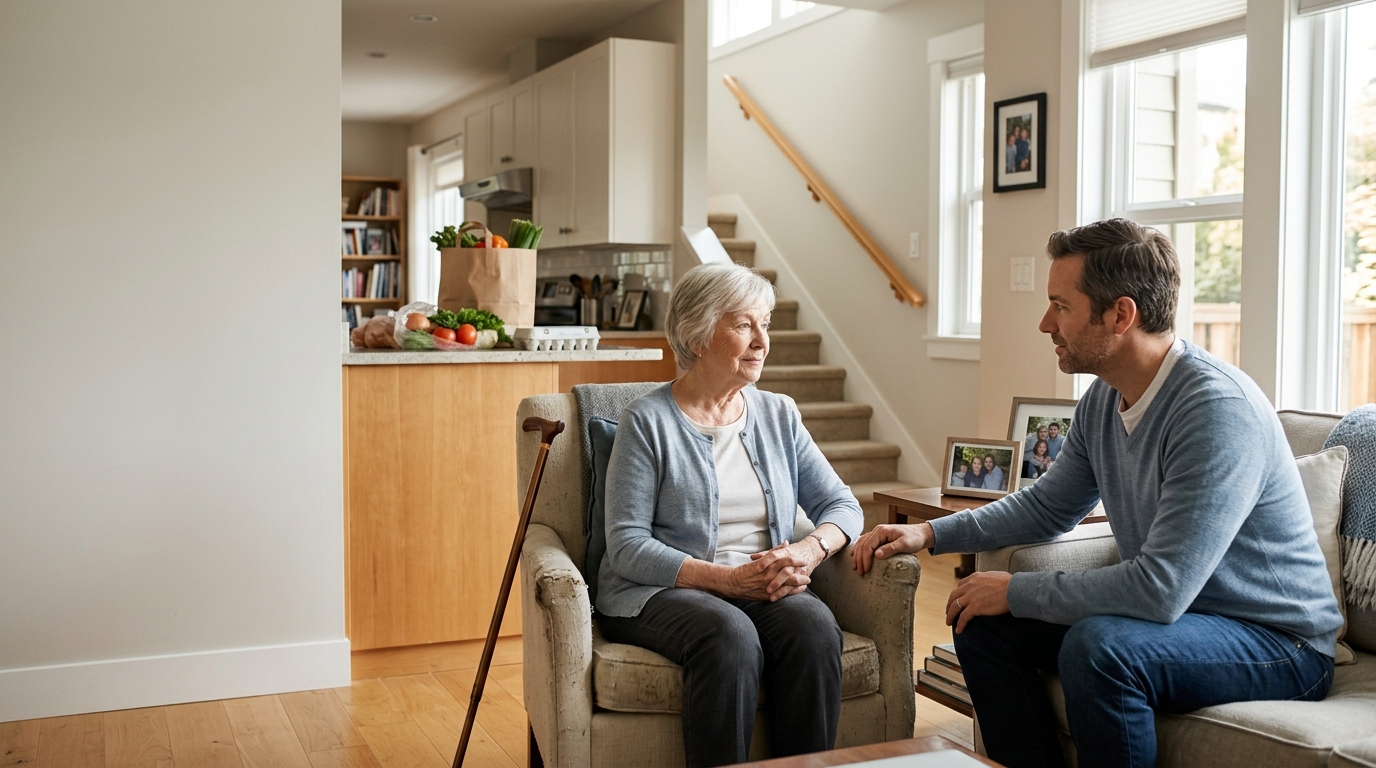
7. Your Parent Is Becoming More Isolated
Social isolation can be easy to overlook.
A parent may gradually stop going out, stop participating in activities, or spend most of the day alone.
You may notice:
- Fewer social interactions
- Loss of interest in activities
- Reluctance to leave the house
- Long periods spent alone
- Increased dependence on family members for social contact
Companionship is not just about having someone to talk to.
Regular visits can provide structure to the day, encouragement to stay active, help with errands, and another person who can notice changes that family members may otherwise miss.
8. Your Parent Has Stopped Doing Things They Used to Enjoy
Changes in everyday behaviour can be an important signal.
Maybe your parent used to:
- Walk around the neighbourhood
- Attend church or community activities
- Go shopping
- Prepare meals
- Garden
- Visit friends
- Drive to appointments
- Participate in hobbies
If those activities have gradually disappeared, ask why.
It may be physical limitations. It may be fear of falling. It may be memory changes. Or your parent may simply need more help than they are comfortable admitting.
Understanding the reason is more useful than simply asking whether they are "still independent."
9. Your Parent Is Struggling With Everyday Tasks
One of the most useful ways to assess the situation is to look at daily activities rather than focusing only on age.
Can your parent safely:
- Get dressed?
- Bathe?
- Use the bathroom?
- Prepare food?
- Move around the home?
- Get in and out of bed?
- Manage basic household tasks?
- Get to appointments?
- Keep track of important routines?
- Respond appropriately in an emergency?
If several of these tasks are becoming difficult, it may be time to increase support. Learn more in How to Know When a Parent Needs Help at Home.
10. Family Members Are Constantly Checking In
Sometimes the strongest warning sign is what is happening to the family.
If family members are:
- Calling several times a day
- Driving over frequently to check on a parent
- Managing groceries and meals
- Taking over household tasks
- Monitoring medications
- Coordinating appointments
- Worrying whenever a call is not answered
the current arrangement may no longer be sustainable.
This does not automatically mean your parent needs to move.
It may mean the family needs another layer of support.
Does Needing Help Mean Your Parent Can't Live Alone?
Not necessarily.
This is one of the most important distinctions for families to understand. There is a significant difference between:
"My parent cannot safely live alone."
and
"My parent should not have to manage everything alone."
An older adult may be perfectly capable of continuing to live at home while receiving help with the things that have become difficult.
For example, someone may be independent with eating, dressing, and using the bathroom but need help with:
- Bathing
- Meal preparation
- Housekeeping
- Transportation or errands
- Companionship
- Mobility
- Getting ready in the morning
- Getting ready for bed
Home care can sometimes fill those gaps without requiring a move. Support can range from a few hours per week to more regular assistance — learn more in How Many Hours of Home Care Does a Senior Need?
What If Your Parent Refuses Help?
This is extremely common. Your parent may say:
"I don't need anyone coming into my house."
Or:
"I've managed perfectly well on my own."
Arguing about whether they are "capable" usually does not help.
Instead, focus on the specific problem.
If bathing has become difficult, talk about help with bathing. If meals are the issue, talk about meal preparation. If loneliness is the problem, talk about having someone visit for companionship.
Starting with a small amount of support can also make the idea feel less threatening. Learn more in How to Talk to Your Parents About Getting Home Care.
When Is Home Care Enough?
Home care may be appropriate when your parent can still live safely at home but needs assistance with certain activities.
The right amount of care depends on the person's needs.
Some people may need only a few hours each week. Others may need daily visits, overnight support, or substantially more assistance.
The important thing is to look at the actual care needs rather than choosing a number of hours simply because it seems typical. Learn more in How to Choose the Right Home Care for a Loved One.
When Might Living Alone No Longer Be Appropriate?
There are situations where home care may not provide enough support on its own.
For example, a parent may require a level of supervision or assistance that cannot realistically be provided through scheduled home care visits.
Concerns may be greater when someone:
- Has frequent serious falls
- Wanders or becomes lost
- Cannot safely be left alone for extended periods
- Has significant cognitive impairment
- Cannot reliably respond to emergencies
- Requires extensive assistance with most daily activities
- Has complex medical needs requiring ongoing professional care
- Is repeatedly hospitalized because of safety concerns at home
In these situations, the family should discuss the person's needs with their healthcare team and explore whether a different living arrangement or more intensive level of care is appropriate.
For some families, that may mean increasing home care first. For others, it may eventually mean considering supportive housing, retirement living, or long-term care.
The decision should be based on the person's needs and safety—not simply their age. Learn more in Home Care vs. Long-Term Care: What's the Difference?
A Simple Way to Assess the Situation
If you are unsure whether your parent should continue living alone, look at five areas:
Safety
Can they move around the home without significant risk?
Personal care
Can they bathe, dress, groom, and use the bathroom safely?
Nutrition
Are they eating regularly and able to obtain and prepare food?
Cognitive ability
Can they manage important routines and respond appropriately to problems?
Support
Is there enough family, community, or professional support to fill the gaps?
If there are problems in several of these areas, it is worth having a more serious conversation about additional support.
Don't Wait for a Crisis
Families sometimes wait until something major happens—a fall, hospitalization, medication mistake, or emergency—before considering home care.
It can be better to act earlier.
A few hours of support may help an older adult maintain routines, remain socially connected, and continue living at home safely.
It can also give family members greater peace of mind without immediately making a major change in living arrangements.
The goal isn't necessarily to decide whether your parent can "live alone" forever.
The goal is to make sure they have the right support for where they are right now.
How Vidal Home Care Can Help
For families who want their parent to remain at home but need additional support, Vidal Home Care can connect families with PSWs based on their parent's care needs, availability, location, language, experience, and personality or communication style.
Vidal Caregivers can provide support with personal care, companionship and daily routines, dementia care, post-hospital support, respite care, overnight care, and other needs depending on the Caregiver's qualifications and the care arrangement.
Families can review Caregiver profiles and choose a Caregiver who appears to be a good fit for their parent.
That can provide another option between managing everything alone and making a major change in where a parent lives.
Questions to Ask Yourself
If you're wondering whether your aging parent should continue living alone, ask:
- Have there been any recent falls or near-falls?
- Is my parent managing bathing, dressing, and toileting safely?
- Are they eating regular meals?
- Are medications being managed correctly?
- Are there noticeable memory or judgment changes?
- Is the home becoming increasingly difficult to manage?
- Are they becoming isolated?
- Can they respond appropriately if something goes wrong?
- How much help is the family already providing?
- Would a few hours of professional support address the main concerns?
- Does my parent need supervision that scheduled home care cannot provide?
- What does their healthcare provider recommend?
You do not need to answer "yes" or "no" to every question.
The purpose is to identify where the gaps are and determine what kind of support could make the situation safer and more sustainable.
FAQ
Frequently asked questions
The Bottom Line
An aging parent does not necessarily need to stop living alone simply because they are getting older or need some help.
The better question is whether they can safely and comfortably live at home with the right support.
Look for changes in falls, personal care, nutrition, medications, memory, household safety, social isolation, and everyday functioning.
If there are gaps, those gaps do not automatically mean your parent needs to move.
Sometimes the right answer is simply more support at home.
Looking for the right support for your loved one?
Tell us what your loved one needs at home. Compare qualified Caregivers.
And choose someone who feels like the right fit.
Free, no-obligation conversation.